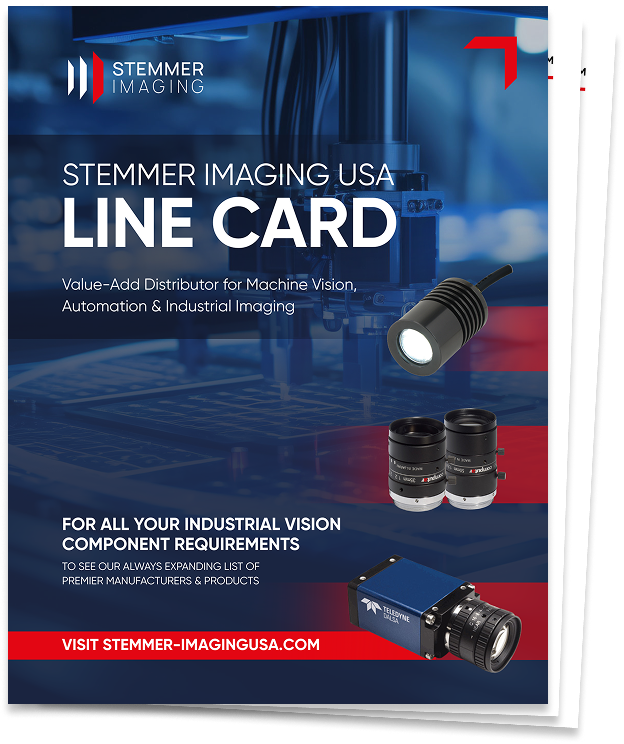
40+ Premier Vision Manufacturers
Download our comprehensive line card to browse premier brands across cameras, lenses, lighting, and sensors.

In the medical field, quality standards are as high as they come and documentation requirements are rigorous. Every device or instrument must meet strict regulatory guidelines (FDA, ISO 13485, etc.), where precision, reliability, and traceability are not just goals but mandates. To meet these demands, manufacturers have widely embraced advanced machine vision - using industrial cameras, sensors, and AI-driven software - to automate inspection and measurement tasks that were once prone to human error. The result is that medical devices from surgical tools to diagnostic kits are produced with consistently higher quality, helping protect patient safety and improve healthcare outcomes.
Modern vision technology is a driving force behind this progress. Industry standards like GigE Vision® and Camera Link® have led to smaller, feature-rich cameras and high-performance interface hardware, enabling faster data throughput and higher resolution imaging. Vision systems are deployed to automate critical processes such as verifying package seals, checking part dimensions, detecting surface defects or contamination, and validating printed codes and labels on devices. These innovations provide error-free, real-time analysis at production-line speeds, ensuring that every product meets design specifications and sterility requirements.
Your Trusted Partner Since 1986
STEMMER IMAGING USA has been a partner to Original Equipment Manufacturers (OEMs), system integrators, and end-users in the medical sector since the dawn of the vision industry. As a premier, vertically-integrated distributor (established 1986), STEMMER IMAGING USA offers deep industry insight and guidance to help you understand your options and achieve the optimal vision solution for your specific needs.
LEARN MORE ABOUT OUR HISTORYKey Vision Applications in Medical Equipment

QUALITY INSPECTION OF COMPONENTS
Automated vision systems play a crucial role in detecting minute defects or deviations in medical parts that human inspectors might miss. High-resolution cameras paired with advanced algorithms can spot microscopic surface irregularities or misalignments, ensuring every product meets safety and performance standards before leaving the factory.

ASSEMBLY VERIFICATION
In complex medical devices, machine vision verifies that all components are present, correctly oriented, and properly assembled. By performing presence checks, alignment validation, and defect detection, automated inspection ensures only fully intact, high-quality devices continue through production, preventing faulty assemblies from reaching clinicians or patients.

PACKAGING AND STERILITY CHECKS
Vision systems verify seals and packaging integrity to ensure medical items are airtight, sterile, and correctly labeled. They also validate UDI barcodes, lot numbers, and expiration dates for accuracy and legibility, catching issues like faint prints or micro-tears that could compromise patient safety or cause misidentification.
TRACEABILITY & COMPLIANCE
Machine vision enables full traceability of medical products. Systems read UDI codes, capture inspection images, and log everything into databases for regulatory compliance. Manufacturers benefit from complete audit trails—from production to patient—reducing recalls and ensuring every device can be tracked with minimal human input.
VISION-ENABLED MEDICAL DEVICES
Embedded vision is increasingly used inside medical equipment—from surgical robots to analyzers and imaging systems. High-resolution cameras and vision algorithms help medical professionals detect issues earlier, enhance accuracy, and perform procedures with greater precision, ultimately improving patient outcomes.
Don't see your specific application? Contact STEMMER IMAGING USA to discuss your custom needs.
Advanced Vision Technologies for Medical Applications
Techniques range from 2D and 3D machine vision to infrared and hyperspectral imaging, often augmented by AI and deep learning, to tackle the diverse inspection challenges of medical manufacturing.
- GigE Vision® and Camera Link® interface standards
- High-resolution imaging for microscopic defect detection
- AI and deep learning for complex pattern recognition
- 2D, 3D, infrared, and hyperspectral imaging capabilities
- Real-time analysis for reflective and transparent materials
Benefits of Machine Vision for Medical Equipment
Automated vision inspection offers around-the-clock consistency that human inspectors can't match, enhancing both productivity and compliance. By leveraging machine vision, medical equipment manufacturers gain capabilities far beyond human vision - leading to higher quality products and more efficient operations. Unlike people, machines do not get tired or distracted, so they can maintain consistent 24/7 inspection accuracy even in high-volume production. They also provide objective, data-driven results for each part inspected, which is invaluable in a regulated industry. Below are some of the key benefits that robust vision solutions deliver in medical device production:
UNPARALLELED PRECISION
Machine vision systems offer accuracy on the order of microns, reliably catching tiny defects or deviations that would elude the naked eye. They detect imperfections, surface flaws, or slight assembly errors with a level of detail that ensures each device meets its exact specifications. This dramatically reduces the risk of a substandard product reaching a patient.
HIGH THROUGHPUT & CONSISTENCY
Vision inspection can be performed at high speeds without sacrificing accuracy. Automated cameras and image processors can examine thousands of parts per hour with the same thoroughness every time. Because machines never tire, their performance remains steady on every shift.
REDUCED COSTS & WASTE
By catching defects early in the manufacturing process, machine vision helps prevent costly downstream waste and rework. It also decreases the likelihood of expensive product recalls or liability issues. While implementing an automated vision system is an investment, the long-term savings are significant.
SCALABILITY & ADAPTABILITY
Modern vision solutions are highly flexible and can adapt to evolving production needs. As product lines change or new device models are introduced, vision systems can be reconfigured or re-trained (especially those with AI and machine learning capabilities) to handle new inspection criteria.
Need Help with Your Medical Application?
Tell us about your medical device application and our specialists will provide tailored product recommendations and expert guidance for FDA/ISO compliance.