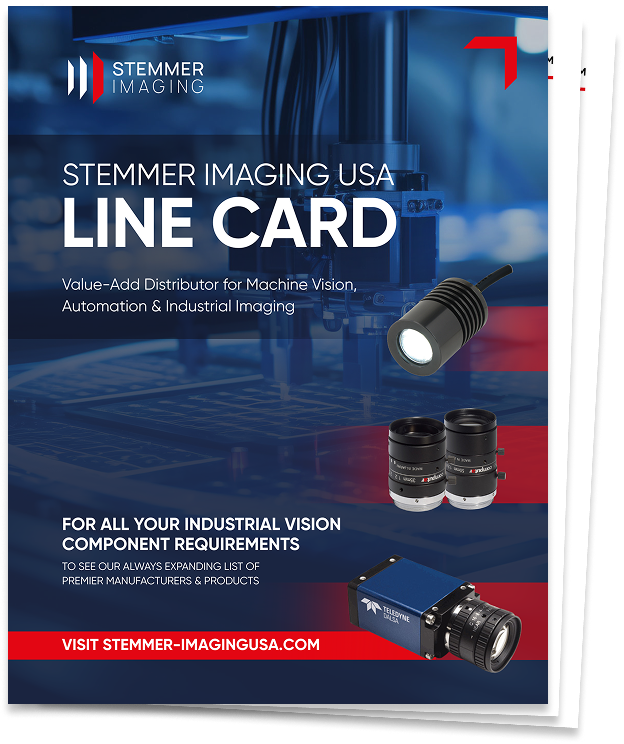
40+ Premier Vision Manufacturers
Download our comprehensive line card to browse premier brands across cameras, lenses, lighting, and sensors.

Cutting-Edge Vision Technology for Autonomous Vehicles
Whether on the ground, in the air, or under water, autonomous (unmanned) vehicles are utilizing advances in vision guidance technology to increase their capabilities and application potentials. New, feature-rich cameras with wide dynamic range, high resolutions, and advanced image stabilizing technologies, packaged in a miniature profile that fits neatly inside a gimbal, are providing the needed flexibility to meet the specific challenges of this expanding industry.
Autonomous vehicles, including unmanned aerial vehicles (UAV), submersibles (ROV/AUV), and unmanned ground vehicles (UGV) such as, trains, trucks, and cars, all require better vision in order to identify the vehicle's position and avoid obstacles. Utilizing vision technologies to perform 360 degree depth scans of the environment, to create 3D mapping for navigation, is essential for any autonomous vehicle. Original Equipment Manufactures (OEM) are finding the features and flexibility they need to meet their design challenges with today's state-of-the art cameras.
Compact, Lightweight Vision Components for Autonomous Platforms
A preferred choice for gimbal OEM's is Sony's wide variety of Block camera modules. These, high reliability, high performance cameras are preferred as a result of their light weight, small size, built-in zoom lens, and long term durability. They also benefit from new add-on interface boards that allow the camera's factory interface to be converted to other interfaces, such as USB 3 and HD-SDI. The introduction of Sony's latest Micro Block camera module is made specifically for this market, with its ultra-small footprint which measures only 16.5mm x 18mm, this tiny camera can fit into any of today's micro UAVs.
Your Trusted Partner Since 1986
STEMMER IMAGING USA has been assisting OEMs, system integrators, and end-users with vision components since the dawn of the vision industry. A premiere, vertically-integrated distributor since 1986, STEMMER IMAGING USA offers you access to an extensive inventory of the industry's premier manufacturers of CCD and CMOS cameras, cables, image acquisition boards, lenses and software products. Our application specialists provide industry insight and guidance to help you select the right products to achieve your specific results.
LEARN MORE ABOUT OUR HISTORYKey Vision Applications in Autonomous Vehicles

Aerial Surveillance & Mapping (UAV/Drone)
Lightweight, high-resolution cameras mounted on UAVs capture detailed aerial imagery for surveying, inspection, and surveillance applications. Wide dynamic range sensors and image stabilization ensure clear images despite vehicle movement, while compact form factors minimize payload weight and power consumption.

Navigation & Obstacle Avoidance
Multi-camera systems and depth sensors provide 360-degree situational awareness, enabling autonomous vehicles to navigate complex environments safely. Real-time image processing identifies obstacles, terrain features, and hazards, allowing vehicles to plan routes and avoid collisions autonomously.
Underwater Inspection (ROV/AUV)
Waterproof cameras with specialized housings and lighting enable inspection of underwater infrastructure, pipelines, marine environments, and subsea installations. Low-light sensitivity and color correction capabilities ensure clear imaging in challenging underwater conditions with limited visibility.
Ground Vehicle Perception (UGV)
Cameras positioned around unmanned ground vehicles provide comprehensive environmental awareness for autonomous navigation in industrial, agricultural, and military applications. Vision systems detect pedestrians, vehicles, and obstacles, enabling safe operation in dynamic environments.
Precision Agriculture & Crop Monitoring
Multispectral and thermal cameras mounted on UAVs monitor crop health, irrigation needs, and pest infestations across large agricultural areas. Specialized imaging enables targeted treatment and resource optimization, improving yields while reducing costs and environmental impact.
Infrastructure & Asset Inspection
High-resolution cameras on autonomous platforms inspect bridges, power lines, pipelines, and other infrastructure without requiring human access to dangerous locations. Close-up imaging reveals corrosion, cracks, and other defects, enabling predictive maintenance and reducing inspection costs.
Don't see your specific application? Contact STEMMER IMAGING USA to discuss your custom needs.
Advanced Vision Technologies for Autonomous Vehicle Applications
Autonomous vehicles require specialized imaging components that deliver high performance while meeting strict size, weight, and power (SWaP) constraints. Key Technologies Available:
- Compact Block Camera Modules optimized for size and weight constraints
- Wide Dynamic Range Sensors for varying outdoor lighting conditions
- Image Stabilization Technology for clear imaging despite platform movement
- Thermal and Infrared Cameras for low-light and night operations
- Multi-Sensor Cameras providing panoramic coverage from minimal installation points
- Ruggedized and Waterproof Housings for harsh environmental conditions
- Low-Power Camera Options extending autonomous vehicle mission duration
- High-Speed Interfaces including USB3, MIPI, and HD-SDI for flexible integration
These components from leading manufacturers enable OEMs to build autonomous vehicles with the vision capabilities needed for safe, reliable operation across diverse applications and environments.
BROWSE OUR TRUSTED BRANDSBenefits of Autonomous Vehicle Vision Systems
Enhanced Capabilities & Mission Flexibility
Advanced vision components enable autonomous vehicles to operate in challenging conditions and perform complex missions previously requiring human operators. Multi-spectral imaging, thermal vision, and wide dynamic range sensors extend operational envelopes across lighting conditions, weather, and environmental challenges.
Safety & Collision Avoidance
Comprehensive vision systems provide autonomous vehicles with the situational awareness needed for safe navigation and obstacle avoidance. Real-time image processing detects and classifies potential hazards, enabling autonomous vehicles to operate safely near people, structures, and other vehicles.
Reduced Operational Costs
Autonomous vehicles equipped with vision systems eliminate the need for human operators in dangerous, remote, or repetitive inspection and monitoring tasks. Reduced labor costs, increased efficiency, and the ability to operate continuously provide significant operational savings across applications.
High-Quality Data Collection
Vision systems on autonomous platforms capture consistent, high-quality imagery and data across large areas or complex environments. Automated data collection eliminates human variability, ensures comprehensive coverage, and provides the detailed information needed for analysis, monitoring, and decision-making.
Need Help Selecting Autonomous Vehicle Vision Components?
Tell us about your UAV, UGV, or ROV application and our specialists will recommend the ideal products from our extensive manufacturer portfolio.