Vision to Reality
Accelerating Surgical Imaging for a Leading Ophthalmic OEM
From Product Vendor to Strategic Partner
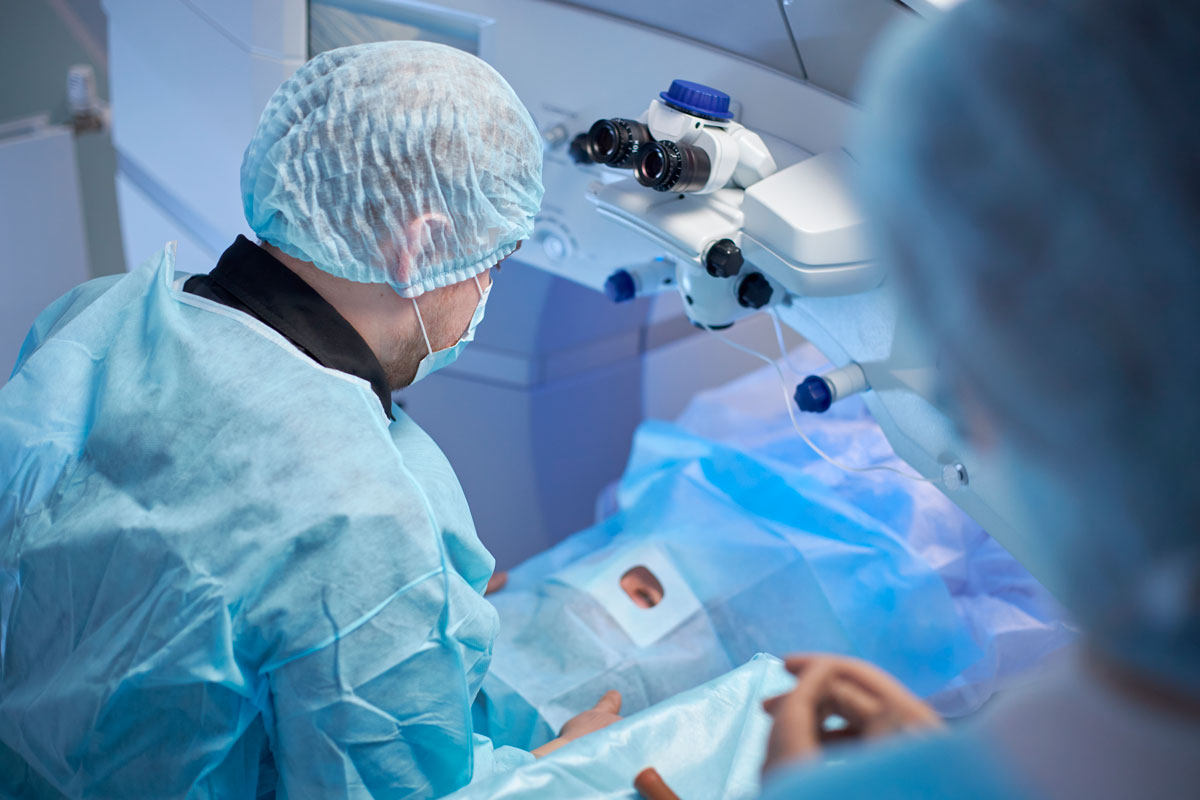
When a leading manufacturer of robotic eye-surgery systems set out to improve surgical efficiency, their engineers knew exactly what they needed: faster, cleaner images to guide the procedure.
What they didn't expect was how much the right partnership would redefine what was possible.
Over the course of several years, their relationship with STEMMER IMAGING USA evolved from a transactional parts supplier to an essential engineering ally - one that could think with them, not just sell to them.
That partnership ultimately transformed a single-camera concept into a synchronized, multi-camera platform that cut imaging time by more than half - without sacrificing the precision demanded in an FDA-regulated environment.
The Challenge: A System Facing Limitations
The OEM’s original system relied on a single, custom camera and a legacy frame-grabber architecture.
It worked - but the application required even faster processing to meet market demand.
Each imaging sequence introduced a noticeable delay, forcing surgeons to pause before proceeding. For doctors performing dozens of surgeries a day, even short delays add up to lost efficiency and reduced patient throughput.
Meanwhile, the company's engineering team faced other constraints:
- Regulatory inertia: Every component change required FDA re-validation.
- Supply inflexibility: Custom parts introduced long lead times and limited scalability.
- Cost volatility: Industry fluctuations and variables such as potential import tariffs on imaging components created sudden pricing uncertainty.
Internally, the company wanted to modernize its platform - but with limited resources and a global manufacturing footprint, they needed a partner who could bridge both engineering insight and operational stability.
The Approach: Partnership in Motion
When the OEM’s team reconnected with STEMMER IMAGING USA, they found a partner ready to engineer with them, not just fulfill an order.
1. Collaborative Design at a Global Scale
STEMMER IMAGING USA’s local applications specialists worked hand-in-hand with the OEM and the camera manufacturer's design team, while being able to leverage STEMMER IMAGING’s European engineering network for deeper optical and timing expertise if needed.
Together, they engineered a solution leveraging an optimized, multi-camera platform, utilizing off-the-shelf components that ultimately outperformed the custom design it replaced.
The synchronization precision required was sub-millisecond, meaning every frame had to align perfectly for 3D image reconstruction. Technical teams coordinated bench testing, firmware validation, and cross-continental collaboration sessions to ensure performance would hold under surgical conditions.
2. Transitioning from Frame Grabber to GigE Vision
One of the most transformative decisions came from rethinking architecture itself.
By switching from a traditional frame-grabber setup to a GigE Vision infrastructure, the OEM eliminated an entire layer of hardware complexity.
Each camera now connected via standardized Ethernet - dramatically simplifying service, reducing cost, and enabling remote diagnostics.
Engineers also designed and supplied multiple custom Ethernet cable assemblies that maintained exact lengths and signal integrity throughout the optical cabinet, ensuring every system shipped was identical in performance.
3. Navigating Regulation and Documentation
Every engineering improvement had to coexist with FDA documentation protocols.
Project managers worked closely with the OEM’s quality team to ensure consistent part numbers, firmware versions, and supplier certifications across prototype and production units. This attention to detail saved months of revalidation time and safeguarded traceability - an often-overlooked factor that can make or break a medtech product line.
4. Building Trust Through Transparency
Midway through production, a 25% tariff was suddenly imposed on key imaging components.
Instead of deflecting, STEMMER IMAGING USA communicated openly, provided a temporary price adjustment, and restored original pricing as soon as exemptions were approved.
The gesture went beyond dollars - it solidified mutual trust and demonstrated that the relationship wasn’t transactional; it was a partnership in practice.
The Results: Measurable Gains, Enduring Relationship
By 2026, the OEM projects well over 100 surgical systems in production, each equipped with multiple cameras, confident that their scaling needs for products will be well supported.
- Imaging time: Improved speed >300% per scan.
- Operational stability: Uniform global supply with forecasted inventory and tariff protection.
- Engineering scalability: New platform ready for software updates, multi-camera calibration, and future AI-assisted analytics.
- Ongoing collaboration: Long-term relationship expanding into new optical and digital services.
Behind those metrics is a story about how partnership works when both sides invest in the long game. The OEM gained an extension of its own engineering force; STEMMER IMAGING USA gained a trusted customer whose innovation keeps pushing both companies forward.
Why This Matters
This success wasn’t about selling cameras - it was about co-creating capability. STEMMER IMAGING USA’s unique blend of local accountability and global infrastructure gave the client confidence that every detail was covered.
For engineers, it demonstrated that partnering early with an experienced vision integrator can accelerate innovation.
For executives, it showed how choosing a distributor with real engineering and logistical depth mitigates business risk, regulatory exposure, and time-to-revenue.
Today, that same partnership model powers projects in life sciences, semiconductor inspection, and advanced manufacturing - all starting with a simple idea: vision, supported by people who can make it real.
Insights from the Field
- Collaboration shortens innovation cycles - when your supplier can think like an engineer, projects move faster.
- Lifecycle consistency protects approvals - documentation and part stability matter as much as innovation.
- Transparency builds trust - open dialogue through tariff or supply challenges fosters long-term confidence.
- Global scale meets local care - a distributed network ensures responsiveness and reach.
Looking Forward
With access to STEMMER IMAGING’s worldwide engineering and logistics ecosystem, the U.S. division now supports customers from prototype through production with seamless continuity.
Future projects include integrating on-board calibration tools, AI-based inspection, and automated testing systems - proving that what began as a single project has evolved into a sustained technology alliance.