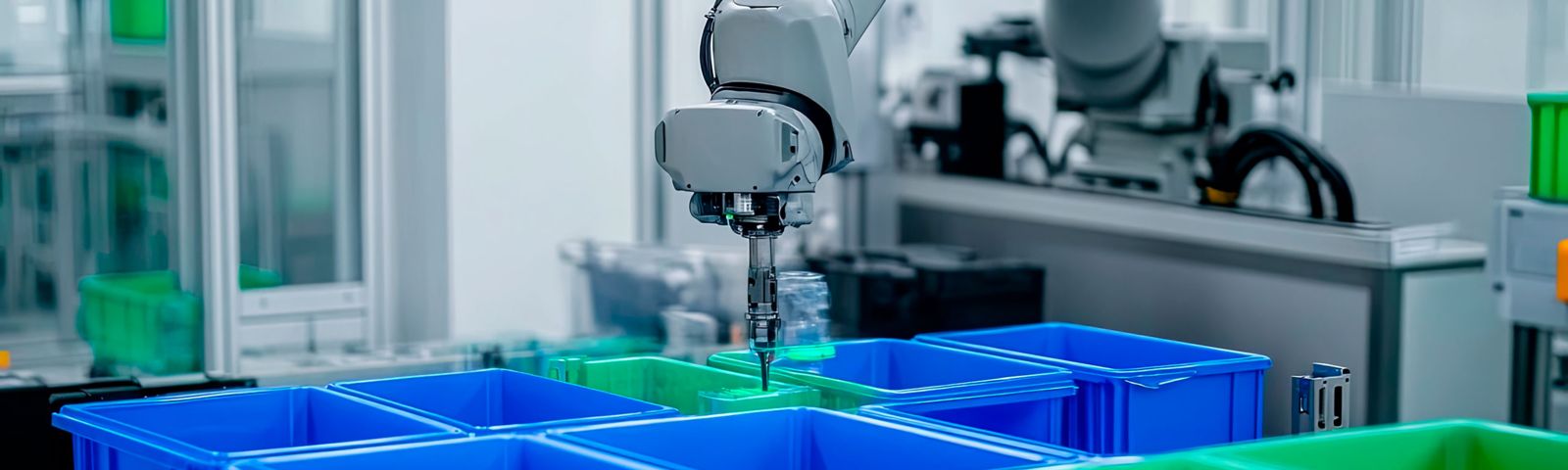
How 3D Vision, CAD Matching, and Practical Path Planning Turn Chaos into Reliable Pick-and-Place
If you’ve spent any time around factory automation, you’ve heard some version of the same statement:
“Bin picking is the holy grail.”
It’s not hype. It’s a concise way of describing the gap between what robots do exceptionally well (repeatable, deterministic motion) and what real factories ask them to do more and more often (handle variability and randomness without slowing production).
The reason bin picking is difficult isn’t that robots can’t move precisely. They can. The reason is that you rarely know what the robot will be asked to pick next, where it will be, or whether the robot can safely reach it, especially when parts are piled in unpredictable orientations, occluded by other parts, reflective, or partially buried.
The “bin picking problem” is best understood not as a single application, but as a stack of problems that must all work together:
-
3D perception in clutter (point clouds and noise)
-
Object recognition and pose estimation
-
Pick-point definition and grasp strategy
-
Motion planning and collision avoidance
-
Candidate selection and cycle-time optimization
-
Tooling-aware constraints (your gripper is part of the model, not an afterthought)
Research literature describes full bin-picking automation as challenging precisely because it involves all of these components at once - 3D recognition, pose estimation, grasp planning, path planning, and collision avoidance.
This article breaks down how modern systems solve the problem in the real world, starting with the spectrum of pick-and-place applications and building toward true random bin picking.
Bin Picking Isn’t One Problem - It’s the Far End of a Spectrum
A useful way to explain bin picking (especially to stakeholders who aren’t deep in vision) is to show that it’s the most complex point on a continuum:
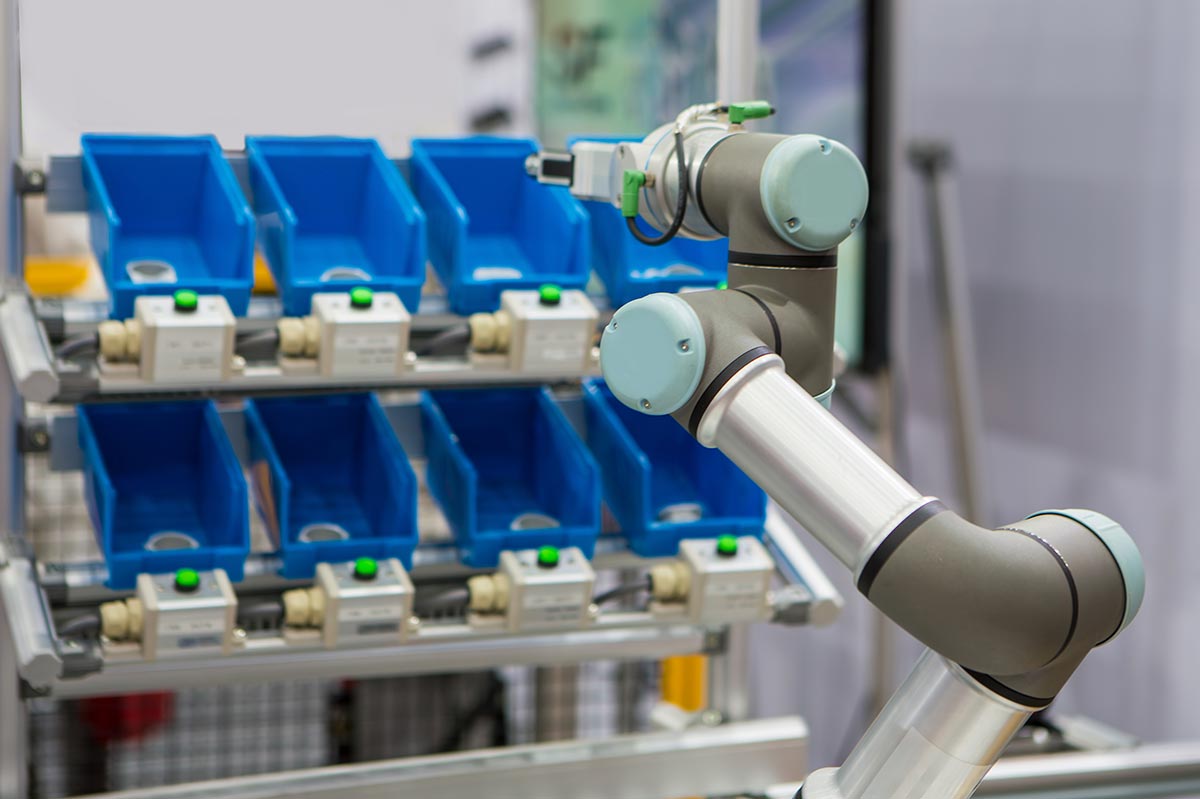
Rack Picking: Structured, Repeatable, Predictable
Parts are placed in known locations. A 3D snapshot confirms position, a CAD match validates pose, and the robot executes a defined approach and grasp. The environment is relatively “clean,” so collision avoidance is simpler.
Semi-Structured Picking: Order Exists, Variability Creeps In
Parts might be arranged on a plane or placed with some repeatability, but they’re not perfectly consistent. The system needs to find multiple candidates, choose a pick order, and maintain throughput.
Random Bin Picking: Chaos and Occlusion Are Normal
Orientation varies, parts overlap, and the system must:
-
identify viable candidates,
-
pick the “best” one first,
-
plan a safe approach path,
-
and repeat - without getting stuck in edge cases.
When engineers talk about “holy grail,” they typically mean this last case: randomness plus constraints. There’s a reason the research community keeps publishing on robust point-cloud handling and cluttered-scene filtering - it’s not trivial.
The Core Challenge: Perception Is Only the Beginning
A modern bin-picking cell starts with perception, usually a 3D camera generating a point cloud, but perception is only step one. From there, the system must compute what you might think of as a “decision chain”:
-
Acquire 3D data (point cloud) of the scene
-
Match candidate objects (often CAD-based matching/template matching)
-
Select a pickable candidate (topmost, reachable, stable, non-colliding)
-
Compute pick points (based on a “golden” part model and grasp definition)
-
Plan approach + grasp + retreat (with collision constraints)
-
Execute (and recover gracefully if the attempt fails)
Engineers know each step is a deep topic by itself. What makes bin picking hard is that all six steps must be reliable together at production speed.
CAD Matching and the “Golden Template” Concept
One of the clearest ways to explain practical bin picking is the “golden template” concept.
You have a known model of the part (often from CAD). You define one or more grasp points or “grasping poses” on that model, where the gripper should engage and how it should approach.
Then the system looks at the point cloud and says:
-
“Where are the instances of this part?”
-
“Which of these candidates match my model well enough?”
-
“Which of those is oriented in a way that I can actually pick safely?”
This is where bin picking becomes more than object detection. It’s not just “I see the part.” It’s “I see a pose I can execute.”
A key detail that came out in your conversation: symmetry and rotational ambiguity make this harder. If you have a rotationally symmetric part, multiple poses may be functionally equivalent, which forces the grasp definition to be robust across orientations.
Candidate Selection: The Robot Doesn’t Pick “A Part.” It Picks “The Best Part Next.”
In a bin, you may detect many “candidates”. But you cannot pick them all in any order.
A viable candidate generally needs to be:
-
sufficiently exposed (not buried under another part)
-
reachable (robot kinematics and joint limits allow it)
-
graspable (end effector can engage without slipping)
-
collision-safe (gripper won’t hit bin walls or neighboring parts)
-
cycle-efficient (fastest feasible choice that maintains throughput)
That’s why bin-picking systems often include candidate ranking logic: topmost, most accessible, least likely to collide, and fastest to execute.
This is also where simpler approaches fail. You can “find a part,” but if it causes repeated collisions or slow approaches, the cell never scales.
Motion Planning: The Hidden Work Happens Between “Found” and “Picked”
A good explanation from the call is how the robot’s motion is typically decomposed into discrete stages:
Home position
Approach pose (above the bin)
Pre-grasp pose
Grasp pose
Retreat / way out
Leave / place pose
Return home / next cycle
Those poses are not arbitrary. They’re how you control safety and repeatability.
The real challenge: the approach and retreat must be tooling-aware, not just robot-aware. The system must know the geometry of your end effector, its clearances, and what it means to avoid collisions with bin walls and adjacent parts.
This is why collision avoidance remains a cornerstone topic in bin-picking research and development.
The End Effector Is Not a Detail - It’s a Constraint That Drives Vision Requirements
Here’s where many projects go sideways: teams treat the gripper as a separate workstream.
In reality, gripper design influences:
-
what pick points are valid
-
how much clearance is required
-
what orientations are feasible
-
whether “top pick only” is acceptable
-
whether suction, clamp, fork, or hybrid tooling changes the entire strategy
In the transcript, you touched on a very real logistics example: gripper collision checks that eliminate candidates the robot can “see” but cannot safely pick due to flap geometry or physical constraints. That’s exactly the kind of practical feature that separates demos from production.
Camera Placement: Fixed-Mount vs Robot-Mount Is a Cycle-Time Decision
A subtle but important point from your discussion: sometimes the camera is fixed above the work area; other times it’s mounted on the robot (“on the shoulder” or even end-of-arm).
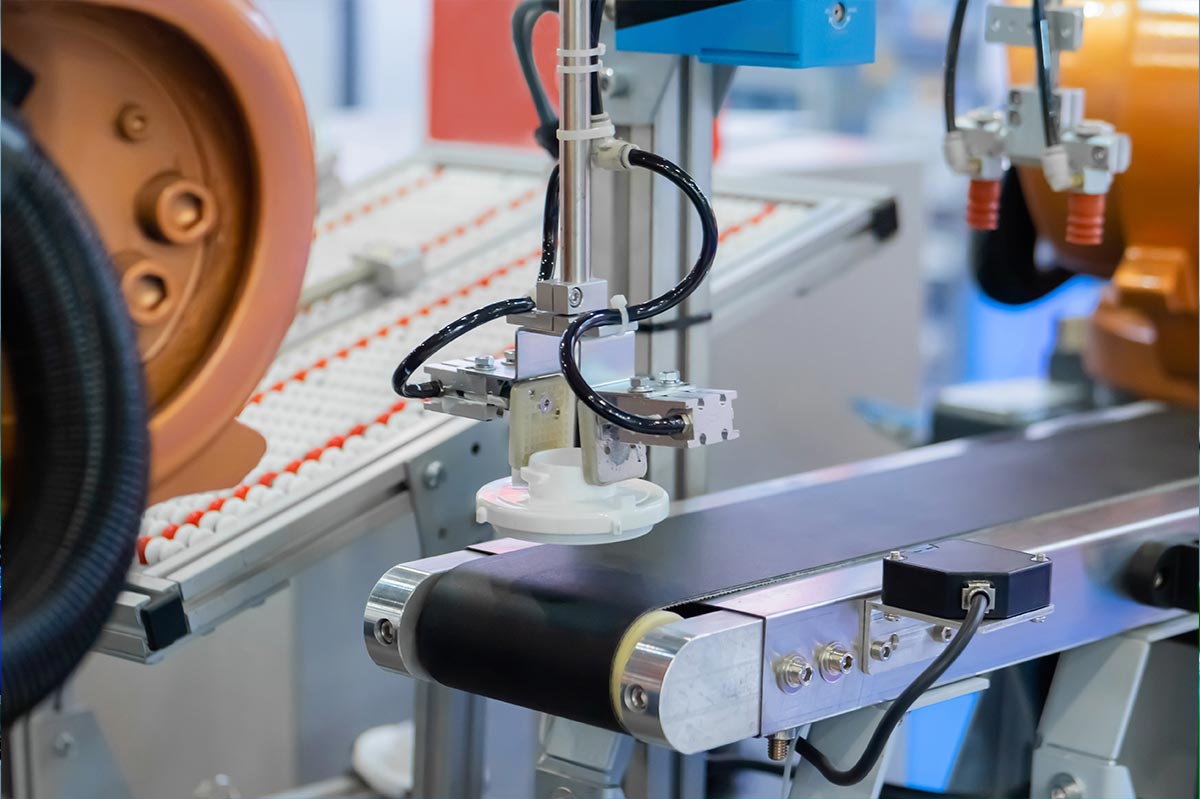
This decision has real implications:
Fixed-Mount (Overhead)
-
simple calibration and stable perspective
-
great for bins, racks, and defined pick zones
-
may struggle with occlusions in deep bins or complex geometries
Robot-Mount (On-Arm / End-of-Arm)
-
can acquire new viewpoints to reduce occlusions
-
useful for complex bins or multi-bin layouts
-
can be optimized so scanning happens “in parallel” while the robot is placing the previous part
This isn’t a philosophical choice; it’s an engineering tradeoff driven by throughput and complexity.
Robots and Ecosystems: Real Adoption Happens Through Robot System Integrators
In many markets, especially automotive and high-throughput logistics, the end user isn’t trying to become a vision expert. They rely on robot system integrators who already know how to build robotic cells, safety systems, conveyors, and controls.
Those integrators often have deep robotics competency but limited appetite (or capacity) to build sophisticated 3D matching and grasp-planning logic from scratch. That’s why a solution that slots into their world, while remaining robot-agnostic, fits the market.
This also aligns with the reality that labor availability is one of the most cited drivers for warehouse robotics adoption, and it’s pushing companies toward automation that can run consistently around the clock.
Business Case: “Labor Shortage” Is the Trigger - But Throughput and Reliability Win the Deal
Labor shortage is often the reason a project starts.
But projects get funded and scaled when engineers can show:
-
consistent cycle times
-
high pick success rates
-
predictable recovery behavior
-
low maintenance burden
-
strong uptime
In other words, the system must be production-grade, not just technically impressive.
This is also where “system thinking” matters. A bin-picking solution that ignores lighting, shielding, enclosures, cable integrity, and serviceability may work in a controlled demo and fail in real deployment.
Where Quality Machine Vision Distributors Add Real Value
In bin picking and robotic handling, success rarely comes from buying a single component. It comes from assembling a reliable solution stack:
-
the right 3D camera for the material/geometry
-
optics/filters/illumination where needed (especially reflective parts)
-
processing hardware appropriate for cycle demands
-
cables and connectors that survive industrial reality
-
support for feasibility testing and integration validation
This is also where the right partner quietly changes outcomes. Integrators and OEM teams move faster when they can source components, validate configurations, and get engineering input without chasing five separate vendors, especially when systems must scale across multiple sites.
The point isn’t “buy from us.” The point is: bin picking punishes gaps in the system, so solutions win when proper component selection, logistics, and expertise are part of the plan from day one.
FAQs: Bin Picking and Vision-Guided Robotics
Closing Thought
Bin picking is called the “holy grail” because it forces automation to deal with reality: randomness, constraints, and production pressure. Modern 3D vision, CAD matching, and practical path planning have made it achievable, but only when the entire system is engineered to work together.
The winners in this space won’t be the teams that chase the most features. They’ll be the teams that design for reliability, integration, and scale, so the cell works the same way on day 300 as it did on day 3.